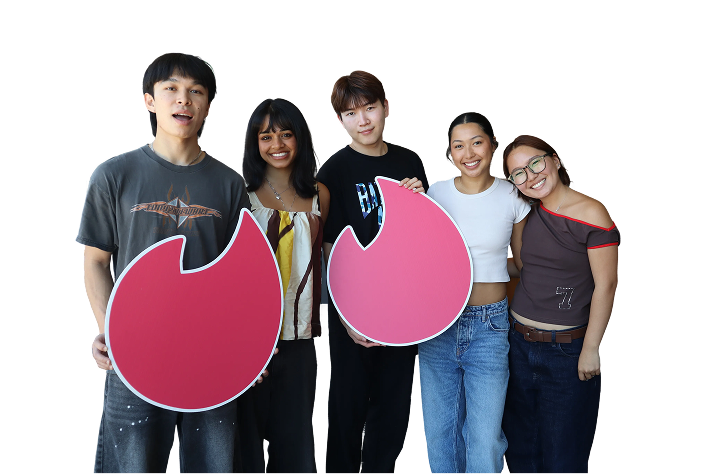
Facilitated client calls during several weeks of the project
I shared our progress weekly and actively discussed emerging findings, pain points, and growth opportunities, using those insights to guide our research direction.

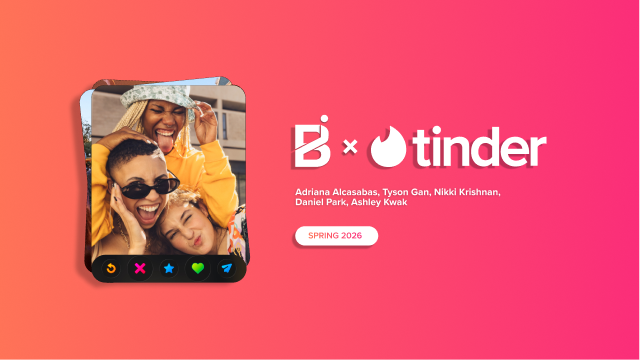
UX Research with Tinder through Berkeley Innovation
We investigated how Gen Z forms connections and meets new people, navigates social expectations in dating, and perceives online dating. Through surveys, interviews, focus group, and participatory research, we identified ways that Tinder could support connection for young adults.
Research Scope: 118 Survey Responses, 30 Interviews, 6 Focus Groups, 3 Diary Studies, 4 Competitive Analyses, Profile Card Workshop
Outcome: Exploratory recommendations and an in-depth research report delivered to Tinder.
Tinder tasked us with exploring how Gen Z defines dating and social connections, experiences safety in person and online, and perceives Tinder compared to other apps. We looked beyond traditional dating to understand how young adults currently meet each other, how they hope to meet each other, and what barriers exist. Our research challenge was understanding what makes meeting people feel natural and meaningful amongst Gen Z’s different preferences and experiences, and how we could translate those qualities online.
“How might we explore how Gen Z defines dating today, what safety looks like for Gen Z women, and how Tinder is perceived among competing dating apps?”
Throughout the course of the project, I worked closely with the team and took on a few different initiatives:
I shared our progress weekly and actively discussed emerging findings, pain points, and growth opportunities, using those insights to guide our research direction.
I established goals for our discussions, structured the flow of questions, and evaluated the balance of personal questions with participants' comfort. For focus groups, I designed questions to evoke group conversation rather than direct question answers.
After noticing an opportunity to deepen our final analysis, I facilitated a team critical-review to analyze broader themes and connect our insights to supporting research before presenting to Tinder
Our research centered on three questions: How does Gen Z define dating and form connections today? What does safety mean for Gen Z women while dating? How does Gen Z perceive Tinder compared to other competitor apps?
| Method | Participants/Material | Purpose of Method |
|---|---|---|
| Survey | 118 responses; 93% Gen Z | Identify general dating patterns, preferences in connection & behaviors. Also gauge an interest in further exploration through focus groups and interviews. |
| Interviews | 30 participants | Understand more personal experiences in dating, challenges, motivations, individual perspectives |
| Focus Groups | 6 groups of 4 participants | Explore social expectations and common desires or challenges through facilitated conversation between participants. |
| Diary Studies | Three documented dating journeys | Understand how the experience of using dating apps to meeting people unfolds. |
| Competitive Analysis |
Four platforms



|
Compare specifically newer dating/connection platforms to Tinder, seeing how platforms specifically created for Gen Z are formatted. |
| Profile-card workshop | Participant-created card | Explore how participants chose to represent themselves and their interests. |

After our initial survey push, we realized that we had relied heavily on our personal social media and circles to gather responses. While this did provide us with responses from Gen-Z audiences, after reviewing our demographic information, we had concerns that these channels were limiting our diverse perspectives.
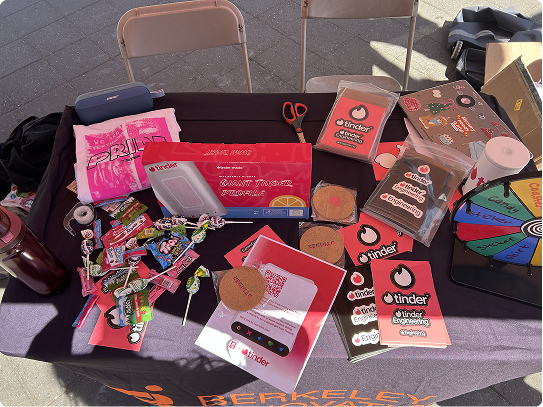
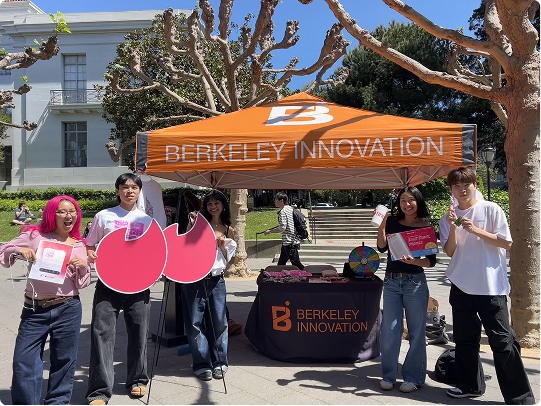
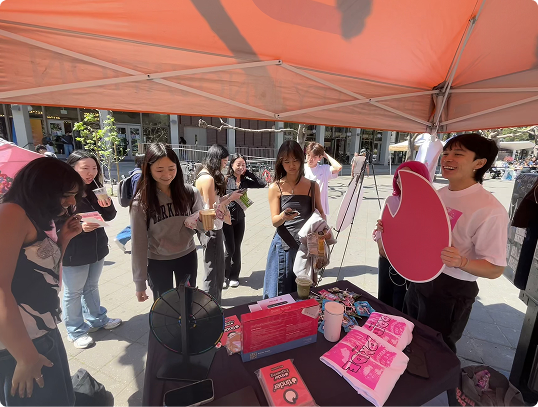
To combat this, we added on-campus tabling with support from the client and merchandise giveaways, to reach a more randomized sample of students.
While this successfully broadened our reach, participation still may have been more limited to students who already had some interest in Tinder and dating culture. Therefore, we treated this as an improvement to our research, but not a complete representation of all different types of young adults with different dating intentions.
~50+ Survey responses; 3 mini interviews/focus groups
73% of respondents identified as female (we specifically wanted more female responses for safety insights and connection pain points)
31% of respondents identified as a part of the LGBTQ+ community
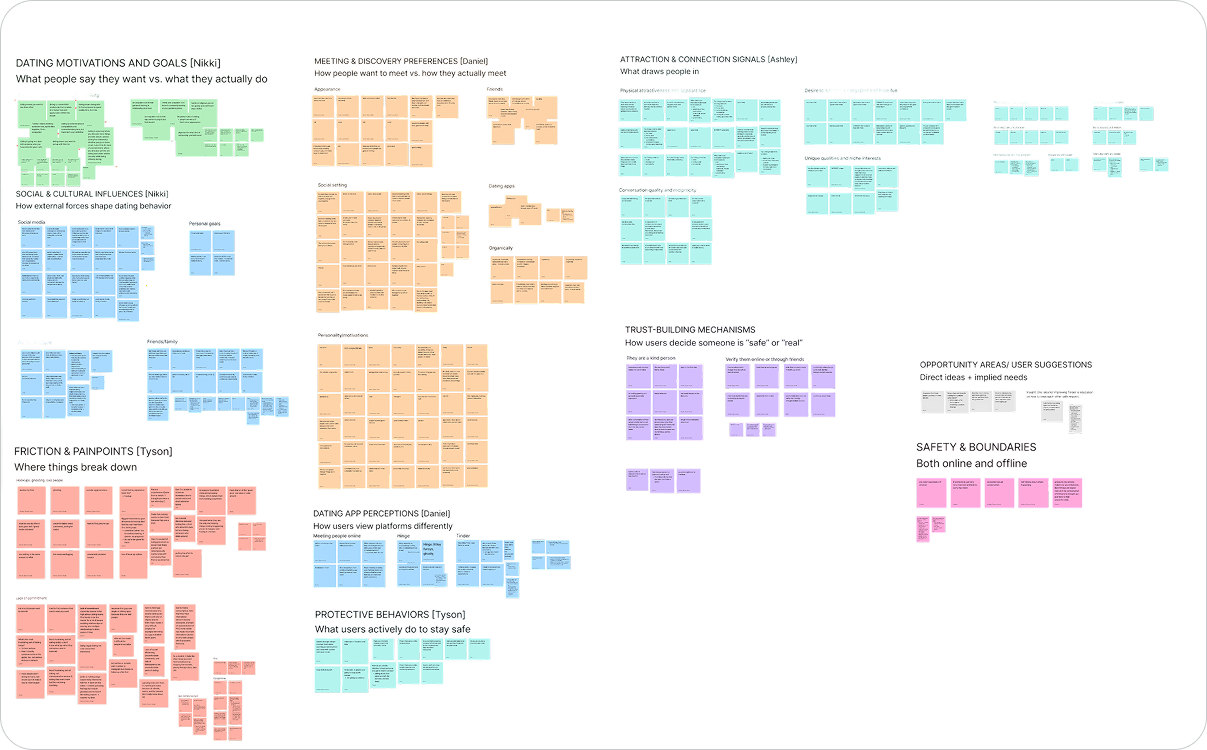
Using affinity mapping, we organized our results, identified patterns, explored contradicting points, and investigated commonalities amongst similar people.
We came across many valuable insights, but here were the 3 most interesting and meaningful ones to me:
Participants described wanting committed relationships but struggling to understand other dating app users’ intentions. Tinder’s Explore tiles, such as “Serious Dater” and “Short-Term Fun,” offer ways to connect around different goals. However, participants’ association of Tinder with casual dating suggested an opportunity to make its support for committed relationships more visible.
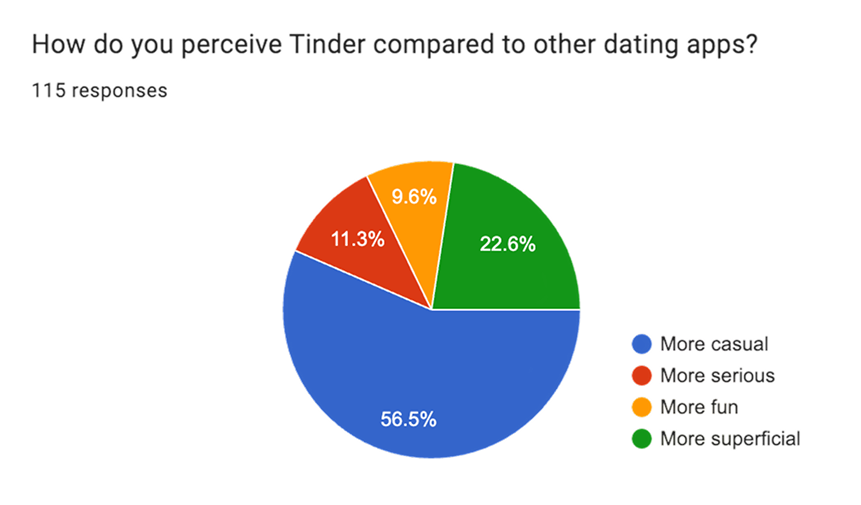
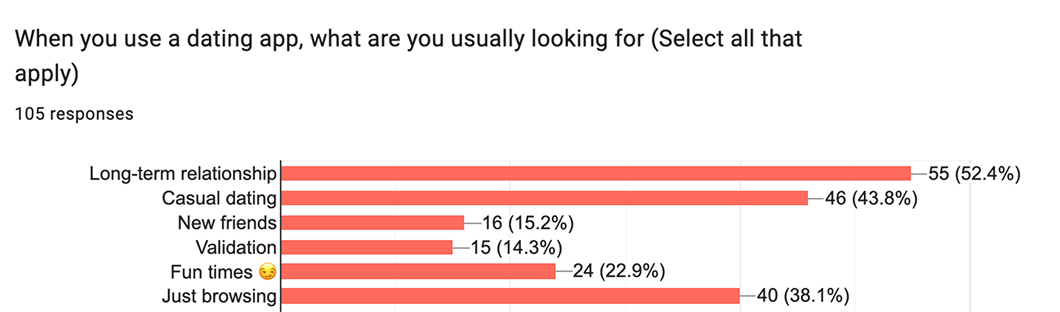
Implication + Opportunity: Tinder could introduce more specific pools of users for different dating intentions to leave users with more confidence in meeting people with similar perspectives and relationship goals.
Participants preferred meeting through classes, events, and shared activities because these settings offered a natural starting point for conversation. Having something in common made getting to know someone feel easier and less pressured than an interaction framed around dating from the start.
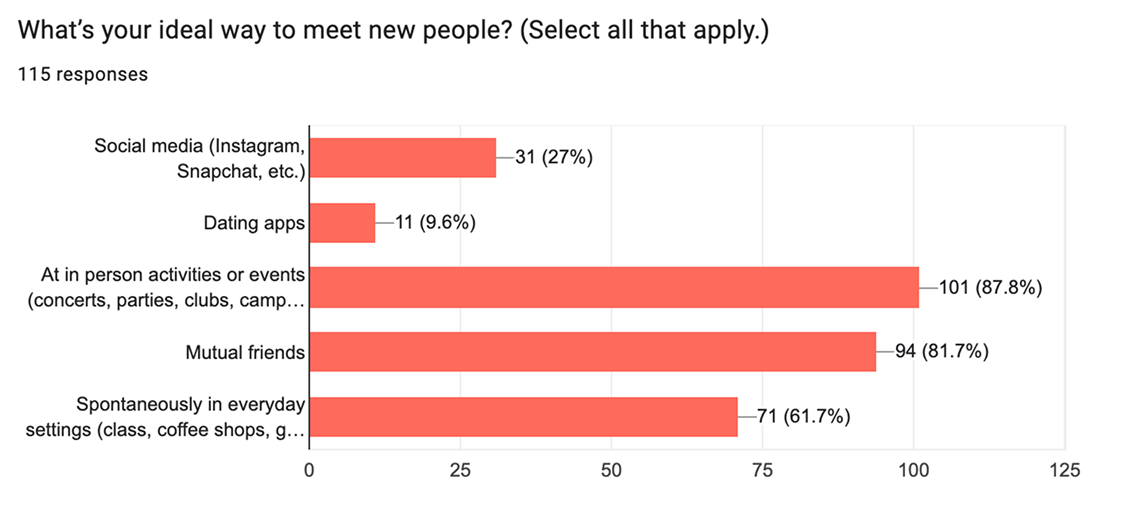
Implication + Opportunity: Tinder could explore interest-based spaces, such as a proposed “Tinder Groups,” where users connect through shared activities in moderated, low-pressure settings. These spaces could help users get to know each other through common interests, with less pressure to meet idealized relationship expectations.
Participants were drawn to niche interests, personal style, and knowledge that gave them something specific to ask or learn about. When people were asked how they wanted to best represent themselves in our profile-card workshop, over photos and quick word responses, they chose to reference their favorite songs, hobbies, photos, and playful aesthetics to communicate their identities. These findings suggested that personal expression could create better opportunities for real connection.
Original note: “I like when they know a lot about something because it leads me to learn something new.”
Implication + Opportunity: Tinder could explore more flexible profile formats that help users express what makes them distinctive and give others specific details to respond to.
Ultimately, we presented our research findings and recommendations to the Tinder UX Research and Product Design teams, delivering an in-depth research report with all of our findings and insights. The presentation synthesized key insights, supporting quotes and statistics, and opportunity areas for the team’s future concept exploration.
Feedback from Client: “A lot of cool insights to look into and explore. Thanks again to you all for doing such amazing work throughout the semester!” - UX and Accessibility Designer at Tinder
Overall, this project taught me how to effectively research a problem scope through a variety of different methods that can reveal different aspects of the same experience.
If I had the opportunity to continue this project, I’d explore those connections further and test how those could be translated into online experiences. I was incredibly interested in finding patterns that help us see familiar behaviors differently and find new ways to do things.
I’m very thankful toward our clients at Tinder, as well as my team!